
Stream III
Petrothermal Electricity Production
Drilling by GTR in the “Ruperti II” geothermal field has shown that the Upper Jurassic Malm reservoir is not capable of providing sufficient hydrothermal flow to generate commercially viable electricity.
The drilling did show that sufficient temperatures in excess of 150 degrees Centigrade were measured in the Malm reservoir, to generate electricity via binary Organic Rankine Turbines.
Since the GTR drilling was completed in 2022, developments in increasing the productivity of geothermal reservoirs using environmentally friendly technologies now provide the potential for the “Ruperti II” permit to generate substantial amounts of green electricity.
Whilst traditional techniques for increasing fluid flow in subsurface reservoirs involve either using acids or high pressure fluid injection to open fractures and increase permeability, GTR is evaluating the more environmentally friendly technologies that can be deployed to create reservoirs that will allow sufficient flow of geothermal fluids to generate green electricity.
What are Hydrothermal and Petrothermal technologies?
Hydrothermal
Hydrothermal geothermal energy is based on the use of hot thermal waters that move along natural pore, fissure and fracture systems in the subsurface.
These are accessed utilising deep boreholes. Whilst the spa industry has been using thermal waters for centuries in Central Europe and worldwide, in the past century, boreholes have also been increasingly used for energy purposes through increasingly deeper drilling to achieve higher water temperatures for heating networks and power production.
Hydrothermal systems are a proven technology and are already successfully used commercially across Germany and many other locations worldwide.
Petrothermal
Petrothermal systems, also called Engineered Geothermal Systems (EGS) and Advanced Geothermal Systems (AGS), are implemented in hydraulically poorly or non-conductive rocks in the almost dry subsurface.
These systems use the heat available at great depths (e.g., 200 °C at a depth of 5 km) and bring in water as a heat-conducting medium from the surface. Technologies that increase the permeability of these systems are available for this process (e.g., drilling technologies, hydraulic stimulation, or acid treatment). Acid treatment is widely used in Bavaria to increase productivity in hydrothermal boreholes in the Upper Jurassic Malm carbonate reservoir.
Recent research and development is providing more environmentally friendly technologies, for example Electrical Reservoir Stimulation that eliminates the need for high-pressure water injection and high-pressure fluid injection induced seismicity.
The geological conditions in many regions of Germany would allow for implementation of petrothermal systems, including in the “Ruperti” permit area.
Image: Geothermal systems for storing and providing heat as well as cooling and electricity. Source: Roadmap for deep geothermal energy for Germany, Fraunhofer IEG, February 2022
Support from the European Investment Bank
To develop a petrothermal techno-economic business plan and submit an application to the European Innovation Fund, GTR is being provided with Project Development Assistance by the European Investment Bank.
Photo: Copyright EIB

History of drilling of KIR-GT2 and KIR-GT2-ST1
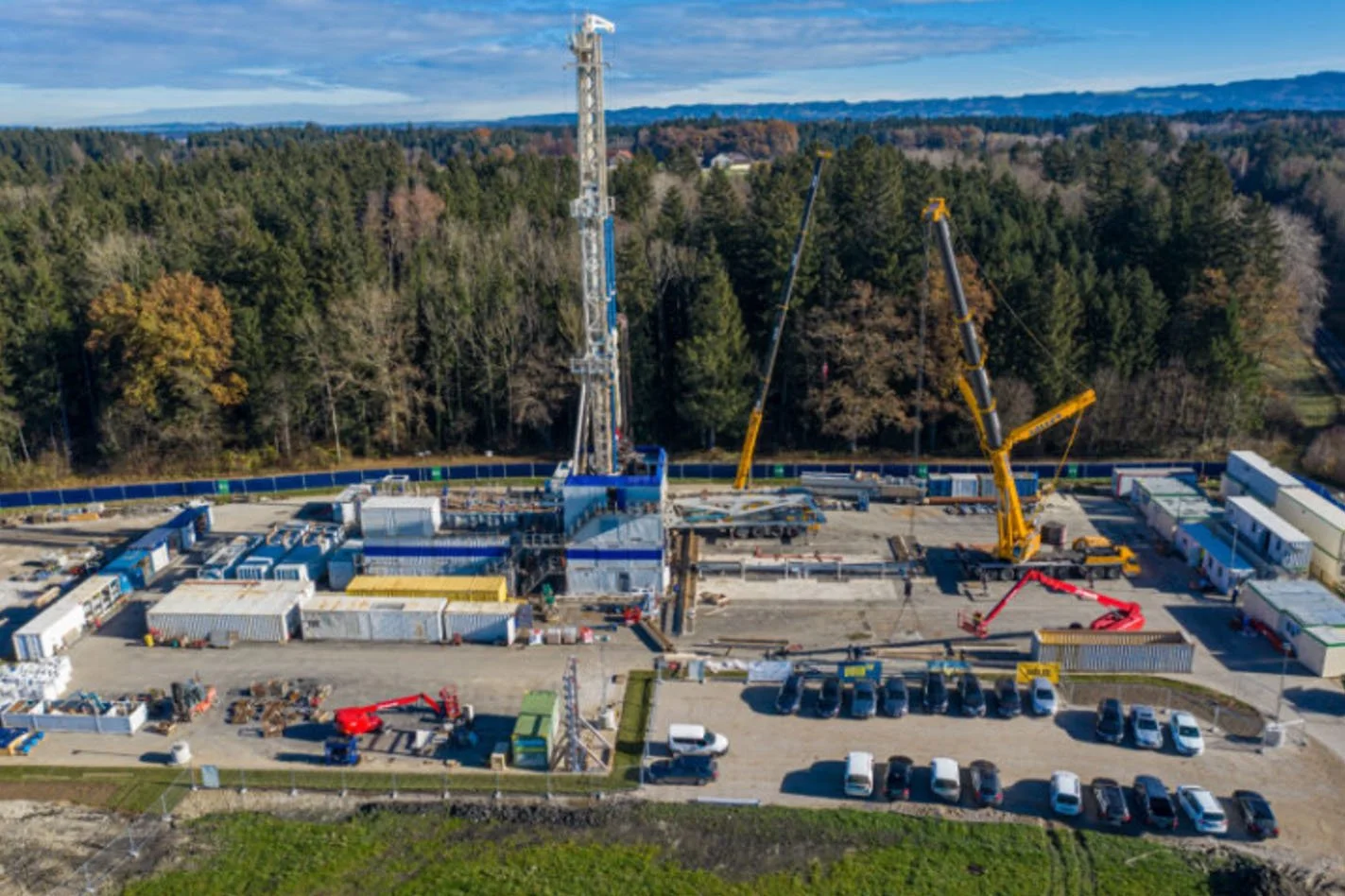
The geothermal drill site near Kirchanschöring lies within the "Ruperti II” mining licence held by GTR for the economic extraction of geothermal energy.
KIR-GT2 and its sidetrack KIR-GT2-ST1 were drilled east of the village of Kirchanschöring, in order to access hot water deposits in the Upper Jurassic Malm reservoir.
A geothermal project was planned with two duplicates (2 production wells and 2 injection wells) with depths between 5’765m and 6’050m MD for regional heat and power generation.
The KIR-GT2 well was drilled first and then tested and stimulated several times. Based on the results of the stimulation and test work, it was planned to drill the other 3 boreholes.
Drilling work began on 21 November 2020 and was completed on 26 April 2021.
KIR-GT2 TD was reached on 10 April 2021 at 6’133m MD , KIR-GT2-ST1 sidetrack drilling began on 3 June 2021, reaching a final depth of 6’217m MD on 11 June 2021. A total of 1’170m of open-hole borehole was drilled in KIR-GT2-ST1.
After completion of the stimulation and testing work in May 2021, GTR decided to backfill the open borehole section and divert the borehole out of the cement bridge as a sidetrack labelled KIR-GT2-ST1 in a southerly direction.
The sidetrack drilling work was completed on 19 June 2021.
The stimulation and testing work on the sidetrack was completed on 11 July 2021 with the installation of the kill string and the construction of the wellhead.
To investigate the target horizon using small core holes ("sidewall coring"), the kill string was removed between 2 and 10 September 2021 and the borehole section to be investigated was cored according to specifications.
The borehole was then completed again with the kill string and backfilled to surface with five cement plugs on 20 November 2022.
There has been no activity on the drill pad since August 2023.
Image: Drilling of boreholes KIR-GT2 and KIR-GT2-ST1